Lecture
Nahum and Habakkuk: God's Mercy and Justice
Listen
In three minutes (computer voice)2:42 · 648 KB
Pastor Hoon Kim explores the seventh-century BC prophetic literature, highlighting the theological balance between Jonah's relentless mercy and Nahum's righteous vengeance against Nineveh. He examines God's covenant jealousy, the power of prayer in Revelation, and Habakkuk's honest prophetic dialogue amidst collapsing world empires.
Downloads
- Three-minute summary (MP3)A short voice message to send648 KB
- Study guide (PDF)Questions for a small groupBest for printing263 KB
- Notes page (PDF)One page to hand out, with room for notesBest for printing200 KB
- Resources (PDF)Notes to prepare your own sermonBest for printing679 KB
- Visuals (PDF)Pictures to show while you teachBest for printing2.8 MB
- Card to share (picture)For WhatsApp, Messenger, or any app139 KB

God's characterThe Word of GodSuffering and trialsPrayerHope and eternityNahum
Study guide
Core Truth
The sovereign God who exercises relentless mercy toward the repentant also executes righteous, covenant vengeance upon arrogant oppressors, calling His oppressed remnant to find refuge in Him and live by prophetic faith amidst shifting world orders.
Key Verse
“The LORD is good, a stronghold in the day of distress; He cares for those who trust in Him.”
Nahum 1:7 (BSB)
Background Notes
- The Geopolitical Crucible: During the seventh century BC (the 600s BC), the ancient Near East experienced massive superpower transitions. The Neo-Assyrian Empire, which had conquered Northern Israel in 722 BC and besieged Jerusalem in 701 BC, entered irreversible decline after Ashurbanipal's reign. Allied forces from Babylon, Media, and Elam besieged Nineveh, destroying the city in 612 BC, fulfilling Nahum's prophecy.
- Covenant Jealousy (Qanna): In Nahum 1:2, God's wrath and vengeance are explicitly tied to His covenant identity. Scripturally, God relates to His covenant people as a faithful husband. When foreign empires brutally exploit His people, divine vengeance is the holy, loving response of a husband intervening to defend His bride.
- The Heraldic Gospel (Euangelion): Nahum 1:15 proclaims the "feet of him who brings good news." In ancient Near Eastern and Greco-Roman antiquity, euangelion denoted the official imperial announcement of a military triumph, the overthrow of an oppressor, or the crowning of a new ruler. The Gospel writers later adopted this term to proclaim Jesus Christ as the true cosmic King who has decisively defeated evil.
- Prophetic Lament and Revelation: Habakkuk illustrates that genuine biblical faith includes honest lamentation. The prophet questions God regarding Judah's domestic violence and the moral problem of using wicked Babylon as an instrument of judgment. God answers by revealing that worldly pride carries its own doom, but "the righteous shall live by their faith" (Habakkuk 2:4).
Discussion Questions
- Understanding the Text: How does understanding God as a faithful husband defending His bride transform our perspective on the terrifying language of divine vengeance in Nahum 1:2?
- Exploring the Themes: Compare the endings of Jonah (Jonah 4:11) and Nahum (Nahum 3:19). How do these two books together demonstrate the perfect balance of God's holy character rather than a contradiction?
- Connecting Scripture: According to Revelation 6:9–11 and Revelation 8:3–5, how do the prayers of suffering believers on earth participate in God's cosmic execution of justice in history?
- Prophetic Imagination: Nahum uses vivid sensory descriptions (red shields, cracking whips, galloping horses, the ruined lion's den) to depict Nineveh's fall. How does cultivating this "prophetic imagination" help us look past the apparent strength of worldly corruption today?
- Personal Application: In Habakkuk 1, the prophet brings raw, honest questions to God when divine actions seem to contradict human logic. What difficult situations in your community or nation do you need to bring honestly before God in prophetic prayer, choosing to trust His refuge?
Phone Summary (WhatsApp)
The sovereign God who showed relentless mercy to Nineveh under Jonah executed righteous covenant justice under Nahum when they returned to cruelty. True faith does not take personal revenge, but offers bold prayers that move the throne of heaven while resting in God during changing world orders. "The LORD is good, a stronghold in the day of distress; He cares for those who trust in Him" (Nahum 1:7, BSB).
Teaching outline
Main Passage: Nahum 1:1–15; Habakkuk 1:1–13
The Big Idea: The sovereign God who shows relentless mercy to the repentant also executes righteous covenant vengeance upon wicked oppressors, calling His faithful remnant to trust His justice and live by prophetic faith during shifting world orders.
Movement 1: The Geopolitical Shift and the Covenant Husband
- Key Scripture: Nahum 1:2; Isaiah 37
- Teaching Point: The seventh-century BC prophets ministered during massive geopolitical transitions as the brutal Neo-Assyrian Empire began to fall. Nahum reveals that God's terrifying wrath is rooted in marital covenant jealousy: God stands up as a faithful husband defending His oppressed bride against a violent predator.
- Core Insight: Divine vengeance is not an emotional loss of control; it is righteous justice that brings comfort and vindication to God's suffering people.
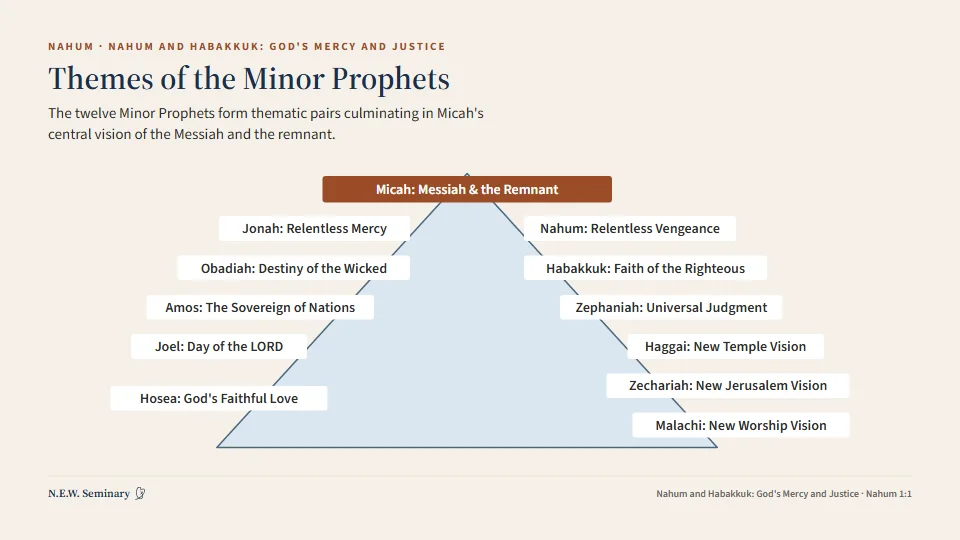
- Visuals: Visual 101 (Themes of the Minor Prophets), Visual 103 (Assyrian Exile Map), Visual 104 (City of Nineveh), Visual 105 (Nahum 1:2 Scripture).
Movement 2: The Spiritual Mechanism of Prayer in History
- Key Scripture: Nahum 1:7; Revelation 6:9–11; Revelation 8:3–5
- Teaching Point: When believers face oppression, they are commanded not to take personal revenge, but to leave vengeance to God. As seen under the fifth and seventh seals in Revelation, the prayers of God's people rise like incense to the heavenly throne room and are answered by fire hurled to the earth.
- Core Insight: In real time, the crying prayers of a local congregation move the sovereign hand of God to execute justice and alter human history.
- Visuals: Visual 1 (A Refuge in Times of Trouble), Visual 2 (Prayers and Divine Judgment).
Movement 3: A Century Apart: Relentless Mercy and Sure Judgment
- Key Scripture: Jonah 4:11; Nahum 3:19
- Teaching Point: Jonah (c. 760 BC) and Nahum (c. 660 BC) present two complementary aspects of God's unchanging holy character toward Nineveh. When Nineveh repented, God extended relentless mercy; when Nineveh returned to chronic cruelty a century later, God executed unyielding justice.
- Core Insight: God's character is consistent, not whimsical. Jonah ends with a question of grace; Nahum ends with a question of justice.
- Visuals: Visual 109 (Jonah and Nahum Compared), Visual 3 (Questions of Grace and Justice).
Movement 4: Poetic Prophecy and the Good News of Overthrow
- Key Scripture: Nahum 1:15; 2:2–3; 3:2–3
- Teaching Point: Nahum announces the downfall of Nineveh as euangelion, the heraldic good news of imperial liberation and lasting peace. Nahum employs vivid visual colors (scarlet warriors, flashing chariots) and acoustic effects (cracking whips, rattling wheels) to cultivate prophetic imagination and guarantee the certainty of God's impending judgment.
- Core Insight: Worldly powers that boast like invincible lion dens will be completely reversed by God's sovereign decree.
- Visuals: Visual 112 (Seventh-Century Prophets), Visual 113 (Nahum and the Minor Prophets), Visual 4 (The Good News of Peace), Visual 115 (Prophetic Imagery).
Movement 5: The Prophetic Dialogue of Habakkuk
- Key Scripture: Habakkuk 1:1–4, 13; Habakkuk 2:4
- Teaching Point: As the Babylonian Empire rose to replace Assyria, Habakkuk engaged in honest prophetic prayer, asking hard questions about internal injustice in Judah and God's perplexing use of wicked Babylon as an instrument of discipline.
- Core Insight: Prophetic prayer does not hide human perplexity; it brings honest questions to God and receives sovereign revelation. In the midst of collapsing empires, the righteous shall live by their faith.
- Visuals: Visual 119 (Seventh-Century Timeline), Visual 122 (Habakkuk's Complaint).
Closing Response
Call the church to renounce personal bitterness, engage in spiritual warfare through intercession for righteous justice, and anchor their faith in the unchanging God who remains a refuge for all who trust in Him.
Prayer
A prayer for “Catalog Basics: Nahum and Habakkuk”
Nahum 1:1
Eternal Creator and righteous Judge,
you live in the heavenly realm and reveal yourself in history.
You are not like false idols without steady character,
for you are both a merciful and a holy God.
Your faithful love reaches to the heavens,
your relentless mercy saves the repentant out of the storm,
and your righteous wrath sweeps away the wicked like a flood.
You are the jealous Husband of your covenant people,
defending and avenging those who belong to you.
You rule over the turmoil and upheaval of shifting empires.
Before your sure judgment, proud fortresses fall into their own water channels,
and the lion's den of worldly royalty is brought to shame.
You remain faithful yesterday, today, and forever,
our good refuge in times of trouble,
caring for all who trust in you.
We confess that we were once your enemies,
deserving your wrath against our sin.
Too often we have followed the trail of unbelieving Jonah,
forgetting that salvation belongs to you alone,
or shared the arrogance of Nineveh and Edom, refusing to repent.
Forgive us for doubting your justice in times of trouble
and wanting to take vengeance by ourselves.
Have mercy on us through Jesus Christ.
We thank you that when we were your enemies,
you poured out your wrath against our sin onto Jesus Christ.
Upon his cross your justice was done and our sin was atoned.
Thank you for the good news that proclaims peace through Jesus, the true Son of God,
and for the prophetic Word that gives us a lens for our times.
Help us to live by faith as your remnant.
Teach us to ask honest questions in prayer like Habakkuk,
and grant us revelation for our past, present, and future.
Let our prayers rise like incense to your golden altar.
Execute justice against corrupt leaders and the evil system of Babylon.
Break the spirits of poverty and oppression,
and protect, provide for, and feed your people.
Here we are, Lord.
We offer ourselves to wait on you, seek your face, and be still.
Trusting your sure judgment, we leave vengeance to you,
loving our neighbors and turning the other cheek.
We give ourselves to prayer at this end time
until you march forward and rejoice over us.
In the name of Jesus Christ, our righteous Judge and King,
be all glory and praise forever.
Amen.
A blessing
May the Lord who is good be your refuge in times of trouble,
for he cares for all who trust in him.
May he proclaim peace to you through the good news of his kingdom,
and keep you living by faith until his justice is done. Amen.¹
¹ Drawn from Nahum 1:7, 15.
Scripture behind this prayer: Nahum 1:1; Nahum 1:2-15; Nahum 2:11-13; Jonah 4:11; Habakkuk 1:1-4; Habakkuk 2:4; Zephaniah 3:8-17; Revelation 8:3-5.
A prayer written with the help of AI to go with Pastor Hoon Kim's lecture. These are not his own words. Shared on 15 November 2026, before its full review.
Scripture quotations: The Holy Bible, Berean Standard Bible (BSB), in the public domain, from eBible.org.
Related teachings
The Prayer in the Belly of the Fish
Pastor Hoon Kim explores Jonah's prayer from the belly of the great fish, revealing how God sovereignly prepares seasons of distress as a womb for the death of the self. Grounded in covenant relationship, true prayer...
Five Means of Grace in the Storm
Pastor Hoon Kim examines Jonah 1:4–17 to reveal five sovereign means of grace God deploys in the storms of life to empty our self-reliance and draw us to genuine repentance. Moving from the tossing of cargo to the...
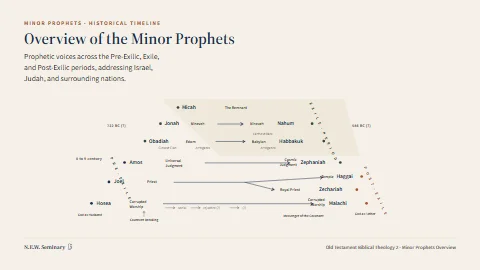
Introduction to the Book of Micah and the Minor Prophets
Pastor Hoon Kim introduces the Book of Micah by demonstrating how the twelve Minor Prophets function as one unified redemptive narrative pointing to Christ and His remnant. He examines the dangerous spiritual rot...