Sermon
Five Means of Grace in the Storm
Pastor Hoon Kim examines Jonah 1:4–17 to reveal five sovereign means of grace God deploys in the storms of life to empty our self-reliance and draw us to genuine repentance. Moving from the tossing of cargo to the provision of the great fish, this message shows that God's relentless pursuit leads ultimately to the saving mercy of the cross.
Listen
The whole sermon
In three minutes
Downloads
- Audio (MP3)9.2 MB
- Three-minute summary (MP3)523 KB
- Study guide (PDF)220 KB
- Resources (PDF)759 KB
- Visuals (PDF)508 KB
- WhatsApp card (picture)126 KB
- WhatsApp messages (text)2 KB
Study guide
Core Truth
In the severe storms of our lives, God relentlessly pursues us not to destroy us, but to empty us of our self-reliance and draw us to repentance through diverse, sovereign means of grace.
Key Verse
"Then the Lord sent a great wind on the sea, and such a violent tempest arose that the ship threatened to break up."
Jonah 1:4 · NIV
Background Notes
- The Literary Design of Jonah: Far from being a simple children's morality tale, the book of Jonah is a masterpiece of Hebrew prophetic satire. Jonah embodies the stubbornness, spiritual blindness, and nationalistic pride of eighth-century BC Israel, while the pagan mariners demonstrate humility, moral sensitivity, and reverence before Yahweh.
- The Key Verb Hitil (To Hurl): The Hebrew verb hitil appears four times in Jonah 1: Yahweh hurls the storm (v. 4), the sailors hurl the cargo (v. 5), Jonah tells them to hurl him overboard (v. 12), and the crew hurls Jonah into the sea (v. 15). The repetition highlights that God is the supreme orchestrator using circumstances to empty human pride.
- The Mirror of the Captain's Command: When the pagan captain tells the sleeping Jonah, "Get up and call out to your god!" (v. 6), he uses the exact two Hebrew verbs (qum, qara) that God originally commanded Jonah in verse 2 ("Arise, go... and call out"). When we ignore God's direct voice, He often speaks His Word back to us through secular, unexpected channels.
- Identity and Religare: The Latin root of religion (religare) means "to bind together" or "to connect." True identity cannot be derived from earthly achievements, job titles, or cultural background, but only through a living, humble relationship with the Creator.
Discussion Questions
- Understanding the Text: Read Jonah 1:4–6. Why do you think Jonah was able to sleep deeply in the lower deck while the experienced pagan sailors were terrified for their lives? What does this reveal about the nature of spiritual denial?
- Examining the Rebukes: In verse 6, God uses an unbelieving ship captain to deliver His message to Jonah. Can you think of a time when God used an unexpected person, perhaps an unbeliever, a coworker, or a family member, to point out a blind spot or speak truth into your life? How did you respond?
- Childlike vs. Childish Faith: Pastor Kim contrasted "childish faith" (throwing tantrums and demanding our own solutions) with "childlike faith" (trusting God's character without demanding instant answers). In your current prayers and struggles, which of these postures best describes your attitude?
- Confession vs. Reality: In verses 8–9, Jonah gives a doctrinally perfect answer: "I worship the Lord, the God of heaven, who made the sea and the dry land." Yet his feet were running in the opposite direction. Where in your life is there a gap between your theological knowledge and your daily obedience?
- Personal Application: Read Jonah 1:17 and 1 Corinthians 10:13. God prepared a great fish to catch Jonah when he was sinking into the deep. Where do you need to stop clinging to your own solutions and trust that God has already prepared His way of grace and rescue for you?
Phone Summary (for WhatsApp / SMS)
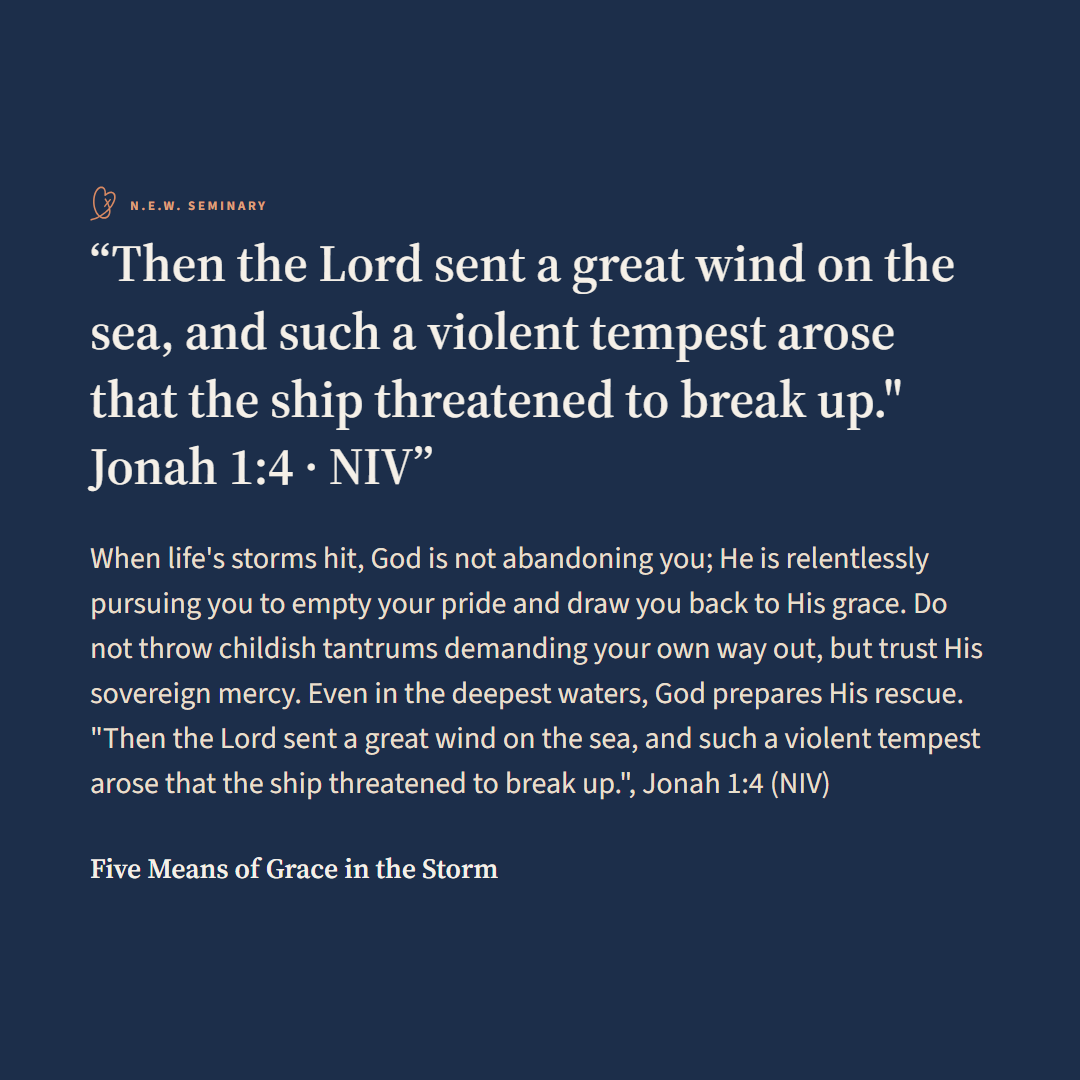
When life's storms hit, God is not abandoning you; He is relentlessly pursuing you to empty your pride and draw you back to His grace. Do not throw childish tantrums demanding your own way out, but trust His sovereign mercy. Even in the deepest waters, God prepares His rescue.
"Then the Lord sent a great wind on the sea, and such a violent tempest arose that the ship threatened to break up.", Jonah 1:4 (NIV)
Scripture quotations taken from The Holy Bible, New International Version® NIV® Copyright © 1973, 1978, 1984, 2011 by Biblica, Inc.™ Used by permission. All rights reserved worldwide.
Teaching outline
- Main Scripture: Jonah 1:4–17
- Big Idea: In the storms of life, God sovereignly pursues us not to destroy us, but to empty our self-reliance and draw us back to Himself through diverse means of grace.
Movement 1: The Storm That Empties Us
- Key Scripture: Jonah 1:4–5
- Insight: The recurring Hebrew verb hitil ("to hurl") shows that God hurled the storm so that the sailors would hurl their cargo and Jonah would be hurled into the sea. God shakes our false securities to empty our hands.
- Illustration: The commercial ship bound for Tarshish was like an international cargo flight loaded with precious merchandise. Everything had to be jettisoned to survive.
- Childlike vs. Childish Faith: Childish faith throws self-centered tantrums demanding immediate solutions, while childlike faith rests securely in God's character (Hebrews 5).
- Supporting Visuals: Visual 1 (Title Card), Visual 2 (Word Study: Hitil), Visual 3 (Childlike vs. Childish Faith).
Movement 2: God Speaking Through Unexpected Voices
- Key Scripture: Jonah 1:6 (cf. Jonah 1:2; Jonah 3:9)
- Insight: When Jonah ignored God's direct command, God echoed His exact words through a pagan captain: "Arise, call out!" (qum, qara). The unbeliever asked for the very mercy Jonah refused to proclaim.
- Illustration: Nathan confronting David with a story about a stolen lamb (2 Samuel 12), bypassing David's defenses to expose his hidden sin.
- Response: We must not harden our hearts when confronted by unexpected messengers, but humble ourselves and repent (Acts 2:37 vs. Acts 7:54–60).
- Supporting Visuals: Visual 4 (God's Voice Through Unexpected Messengers).
Movement 3: Providence Turning Chance into Certainty
- Key Scripture: Jonah 1:7
- Insight: What pagans attributed to luck or fate was actually God's sovereign necessity. God directed the superstitious casting of lots to point directly at Jonah.
- Illustration: Francis Thompson's poem The Hound of Heaven: God relentlessly trails the running soul, closing every door until we surrender.
- Application: A believer who sought out a fortune teller was told, "Go believe in Jesus properly!" Faith recognizes that repeated trials are God's divine appointments, not random accidents.
- Supporting Visuals: Visual 5 (From Chance to Divine Necessity).
Movement 4: The Question That Reveals Our Identity
- Key Scripture: Jonah 1:8–12; Psalm 119:71
- Insight: The sailors' rapid questions ("Who are you?") exposed the chasm between Jonah's orthodox theological confession ("I worship the Lord, the God of heaven, who made the sea") and his rebellious, runaway life.
- Insight on Religion: The word religion comes from Latin religare ("to bind or relate"). We cannot define ourselves by name, job, or nationality, but only in relationship to the personal Creator.
- Application: Affliction shatters our busy, automatic routines and forces us to confront who we are before God.
- Supporting Visuals: Visual 6 (Who Are You?).
Movement 5: The Prepared Fish and the Shadow of the Cross
- Key Scripture: Jonah 1:13–17; 1 Corinthians 10:13; Matthew 12:39
- Insight: Jonah preferred drowning to repentance, but God prepared a great fish to preserve him. God provides a way of escape in every trial.
- Pastor Kim's Story: Stranded in Germany for three months in his late forties with crushing debts and no income, God provided an unexpected gift of accumulated tithes upon his return, clearing the debt in a single day and confirming his pastoral call.
- Climax: The sign of Jonah finds its fulfillment in Jesus Christ, who died and rose after three days to deliver rebellious humanity.
- Supporting Visuals: Visual 7 (The Cross: Ultimate Means of Grace).
Response and Prayer
- Stop running from God's sovereign storm.
- Surrender the pride, self-reliance, and religious masks you have been clinging to.
- Trust that the God who sent the storm has already prepared the cross to rescue and restore you.
Scripture quotations taken from The Holy Bible, New International Version® NIV® Copyright © 1973, 1978, 1984, 2011 by Biblica, Inc.™ Used by permission. All rights reserved worldwide.
Scripture quotations taken from The Holy Bible, New International Version® NIV® Copyright © 1973, 1978, 1984, 2011 by Biblica, Inc.™ Used by permission. All rights reserved worldwide.