Lecture
Introduction to the Book of Micah and the Minor Prophets
Pastor Hoon Kim introduces the Book of Micah by demonstrating how the twelve Minor Prophets function as one unified redemptive narrative pointing to Christ and His remnant. He examines the dangerous spiritual rot beneath eighth-century BC prosperity, calling ministers to embody prophetic lament and thorough repentance.
Downloads
- Study guide (PDF)211 KB
- Resources (PDF)698 KB
- Visuals (PDF)6.6 MB
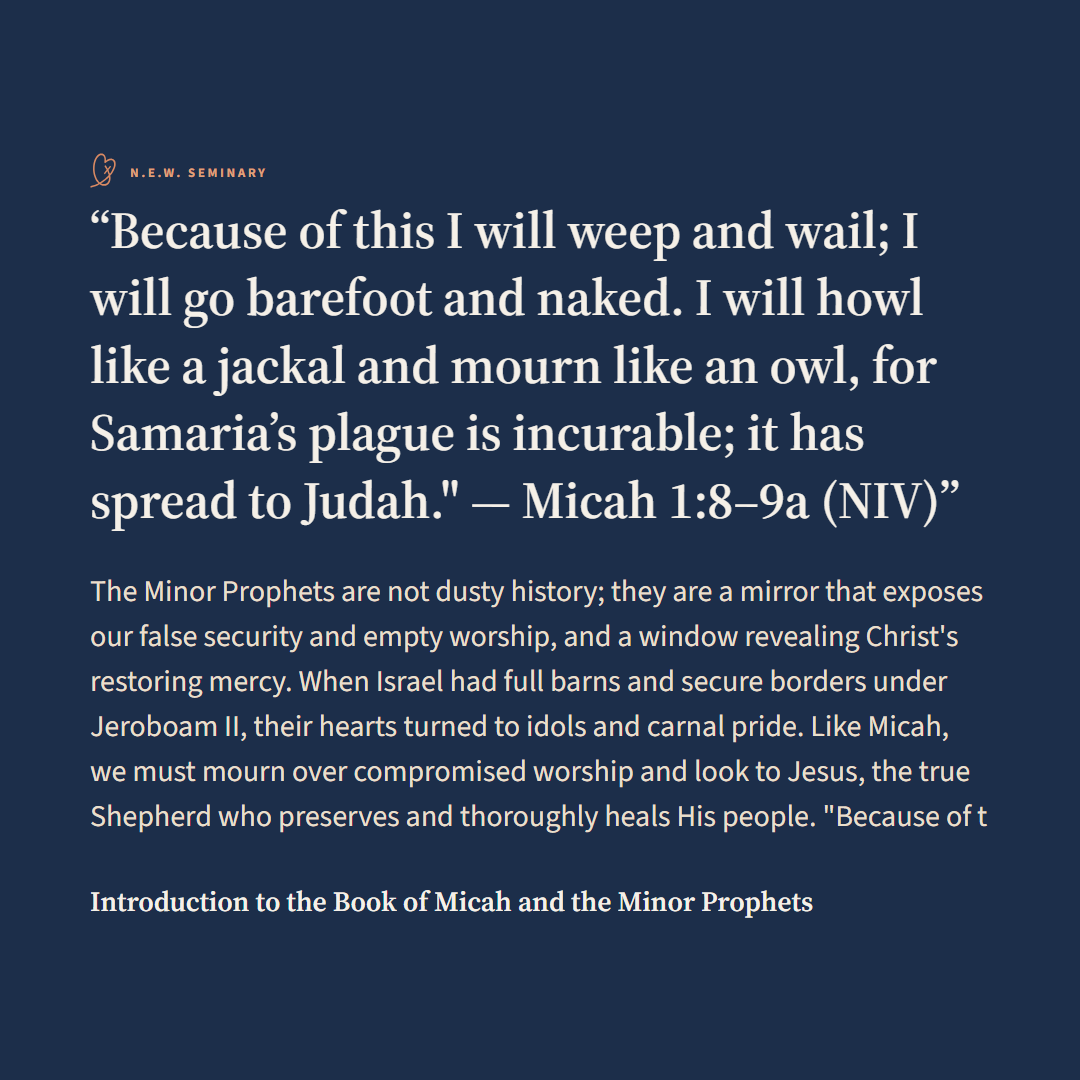
- WhatsApp card (picture)159 KB
Study guide
Core Truth
God calls His church to read the Minor Prophets not merely as ancient history, but as a mirror exposing false security and corrupt worship, and as a window revealing the Messiah who preserves and thoroughly restores a humble remnant.
Key Verse
"Because of this I will weep and wail; I will go barefoot and naked. I will howl like a jackal and mourn like an owl, for Samaria’s plague is incurable; it has spread to Judah." Micah 1:8–9a (NIV)
Background Notes
- The Book of the Twelve: In ancient Hebrew Bibles, the twelve Minor Prophets were written together on a single scroll called The Twelve. Rather than disconnected fragments, they trace a deliberate thematic journey: covenant breakdown, divine discipline, universal judgment, and ultimate restoration through the Messiah.
- The Era of Jeroboam II (c. 789–748 BC): 2 Kings 14:23–29 describes a golden age of northern expansion from Lebo Hamath to the Dead Sea. Because Assyria was preoccupied with internal conflicts, Israel and Judah experienced rapid economic growth. However, this wealth produced systemic oppression, false confidence, and pagan syncretism.
- The Neo-Assyrian Threat: Within a generation after Jeroboam II, Assyria regained military strength under Tiglath-pileser III. Samaria was destroyed in 722 BC, and Sennacherib later marched through the fortified border cities of Judah right up to the gate of Jerusalem (701 BC).
- Prophetic Wordplay in Micah 1: In Micah 1:10–14, Micah uses the literal names of local towns in the Shephelah (Judean foothills) to show how their proudest attributes would become their ruin: Beth Ophrah ("house of dust") rolls in dust; Shaphir ("beauty") is shamed; Lachish ("city of chariots") finds its horses useless.
Discussion Questions
- Understanding the Story: Read 2 Kings 14:23–29 alongside Micah 1:1–5. Why did Israel feel so secure during this period, and what was God's actual assessment of their spiritual health?
- The Prophetic Mirror: Pastor Kim explained that prophetic books act first as a mirror and then as a window. When you look into Micah 1, what subtle forms of self-reliance or formal, empty worship do you see in your own life or church?
- The Heart of a Shepherd: Read Micah 1:8. Instead of gloating over the coming judgment, Micah stripped off his sandals and wailed like a jackal. How does Micah's brokenhearted response challenge the way we respond to moral failure and cultural decay around us?
- Where Do We Place Our Trust? Micah condemned Lachish because it relied on imported Egyptian war chariots rather than the Lord (Micah 1:13). What modern "chariots" (resources, strategies, political influence) are churches and leaders tempted to depend on today?
- Living as the Remnant: Through the window of the prophets, we see Jesus Christ, our true Shepherd. What does it look like practically for a small group or local church to live as God's faithful, humble remnant this week?
Phone Summary (for WhatsApp / SMS)
The Minor Prophets are not dusty history; they are a mirror that exposes our false security and empty worship, and a window revealing Christ's restoring mercy. When Israel had full barns and secure borders under Jeroboam II, their hearts turned to idols and carnal pride. Like Micah, we must mourn over compromised worship and look to Jesus, the true Shepherd who preserves and thoroughly heals His people. "Because of this I will weep and wail; I will go barefoot and naked. I will howl like a jackal and mourn like an owl..." Micah 1:8 (NIV)
Teaching outline
Introduction to the Book of Micah and the Minor Prophets
Main Passage: Micah 1:1–9 (with 2 Kings 14:23–29 and Micah 1:10–14)
The Big Idea: The prophetic word exposes our false security and broken worship as a mirror of repentance, while serving as a window of hope pointing to the Messiah who thoroughly restores His humble remnant.
Movement 1: The Twelve Prophets Form One Story of Redemption
- Scripture: Micah 1:1; 5:2; Habakkuk 2:4; Jonah 3–4; Nahum 1–3
- Insight: The twelve Minor Prophets are not twelve random books. They tell one story: moving from Israel's unfaithfulness (Hosea) to cosmic restoration. Right at the center stands Micah, the "little Isaiah," pointing directly to the Messiah born in Bethlehem and the preservation of a faithful remnant.
- Supporting Visuals: Visual 115, Visual 116, Visual 117
Movement 2: Material Prosperity Can Blind Us to Spiritual Danger
- Scripture: 2 Kings 14:23–29; Micah 1:1–5
- Insight: Under Jeroboam II, Israel's borders expanded from Lebo Hamath to the Dead Sea because the Assyrian Empire was temporarily weak. The people enjoyed peace and wealth, but their full barns led to empty worship and high-place idolatry. When Assyria revived, their false security collapsed.
- Supporting Visuals: Visual 128, Visual 130, Visual 131, Visual 135
Movement 3: Three Voices, One Message for the Heart
- Scripture: Hosea 1:1–2; Amos 5:24; Micah 3:1–4; 6:8
- Insight: The three eighth-century prophets address three deep failures: Hosea asks, "Who is your true Husband?" and calls unfaithful hearts to return (shuv); Amos asks, "Who is your true Master (Ambuye)?" and demands justice (tzedaqah); Micah exposes corrupt leaders and points to God as the true Shepherd and coming King.
- Supporting Visuals: Visual 138, Visual 119
Movement 4: The Prophet Weeps Before He Preaches
- Scripture: Micah 1:8–9
- Insight: When Micah saw the approaching judgment, he did not celebrate. He stripped off his outer clothes, walked barefoot like a captive slave, and howled like a jackal in the night. True pastoral and prophetic ministry begins with tears and intercession over the broken state of the church.
- Supporting Visuals: Visual 1 (Wordplay and Lament)
Movement 5: False Security Falls, but Restoration is Thorough
- Scripture: Micah 1:10–14
- Insight: Micah played on the names of Judean towns: Shaphir ("beauty") was stripped naked, and Lachish ("chariot city") found that its imported horses could not save it from God's holy fire. Yet just as God's discipline touched every town, His restoring grace in Jesus Christ reaches every village, community, and nation.
- Supporting Visuals: Visual 137, Visual 2 (Study Handout)
Closing Response
Examine your heart before God:
- The Mirror: What are you leaning on instead of God? Is it money, buildings, reputation, or human connections?
- The Window: Look through your weakness to Jesus Christ. Repent thoroughly, and walk humbly with your God as part of His restored remnant.
Scripture quotations taken from The Holy Bible, New International Version® NIV® Copyright © 1973, 1978, 1984, 2011 by Biblica, Inc.™ Used by permission. All rights reserved worldwide.